
Ionising radiation
METAS guarantees the metrological traceability of measurements of ionising radiation and thus creates an important basis for their safe and reliable use in medicine, research and radiation protection.
Measuring ionising radiation in everyday life
Ionising radiation is a form of radiation that has enough energy to ionise atoms and molecules, i.e. remove electrons from their shells. It occurs naturally in our environment and we encounter it every day – for example, through cosmic radiation from space and through natural radioactive substances in the soil or in food. It is also artificially produced and used in a targeted manner in medicine, research and industry.
Precise measurement of this radiation enables safe use and is essential for radiation protection. METAS ensures that measuring instruments for ionising radiation measure correctly and in a traceable manner.
Typical applications of measuring ionising radiation
The measurement of ionising radiation is used in various areas, such as:
- in dose determination in radiotherapy
- in activity measurement for imaging procedures and therapies in nuclear medicine
- in the protection of staff and the general public against radiation
- in the monitoring of radioactive substances
- in the quality assurance of medical irradiation facilities
- in research
Our services in the field of ionising radiation
Verifications
The use of numerous measuring instruments for ionising radiation is subject to federal regulations. In particular, regular verifications ensure the proper functioning of these measuring instruments and serve the safety of patients, specialists and the general public.
At METAS, we offer verifications for:
- Radiation therapy dosimeters
- Activimeters for nuclear medicine
- Measuring devices for radon gas
Verification of therapy dosimeters
The following measurement options are available for the therapy dosimeters:
- Absorbed dose to water for high-energy photon radiation:
Tissue-phantom ratio TPR2010 between 0.639 and 0.802 (4 MeV to 21 MeV) - Absorbed dose to water for high-energy electron radiation:
Half-value depth R50 between 1.75 g/cm2 and 8.54 g/cm2 (5 MeV to 22 MeV) - Absorbed dose to water for 60Co gamma radiation
- Absorbed dose to water for soft X-rays between 10 kV and 100 kV
- Absorbed dose to water for medium energy X-rays between 100 kV and 300 kV
- Air kerma for 60Co-gamma radiation
- Air kerma for soft X-rays between 10 kV and 100 kV
Verification of activimeters
In the case of activimeters, we perform various tests and reference source measurements to verify the functionality and measurement stability of the instruments.
Verification of measuring devices for radon gas
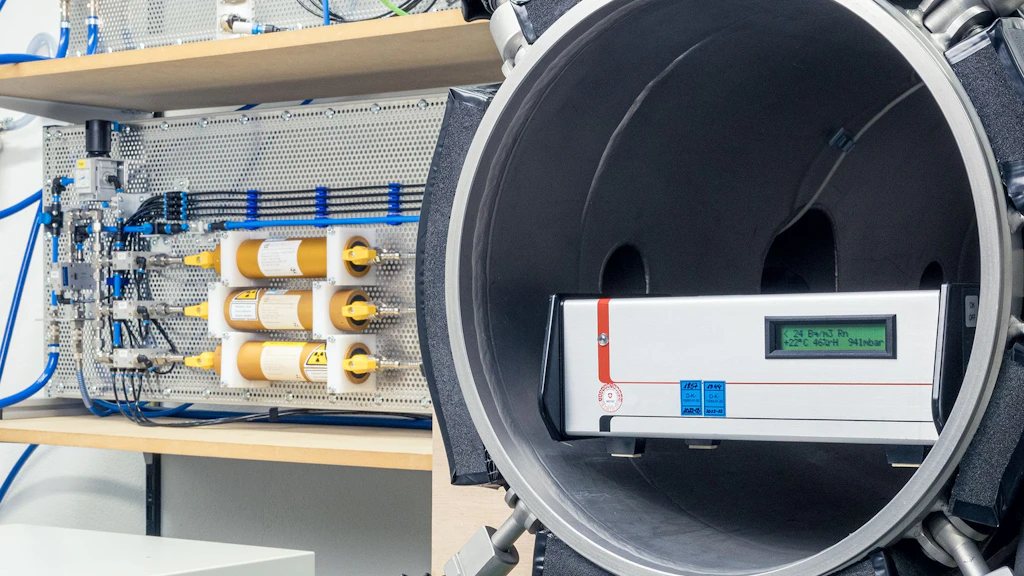
We expose measuring devices for radon gas to different activity concentrations in a radon chamber and check their display values.
Verifications by authorised verification laboratories
We offer our verification services in the field of ionising radiation together with the following two authorised verification laboratories:
The mandated verification laboratories offer verification for the following measuring instruments:
- Radiology dosimeters (IRA)
- Surface contamination monitors (PSI, IRA)
- Measuring devices for ambient dose rate (PSI, IRA)
- Well-type ionisation chambers for HDR brachytherapy with Ir-192 (IRA)
- Comparative measurements for activimeters (IRA)
More information on the cooperation with the PSI and the IRA can be found on the page “Designated institutes of METAS”.
Approval and type examination
We issue national approvals for measuring instruments for ionising radiation and carry out type examinations.
Information on submitting an application for approval of a type can be found in the “Application for approval of measuring instruments for ionising radiation” form:
Calibrations
From 2027, we will be offering calibration services for the following measuring instruments at METAS:
- Radiotherapy dosimeters
- Measuring devices for radon gas
- Activimeters
Is the service you are looking for not listed on the website? Please do not hesitate to contact us so that we can work together to find a customised solution to your problem.
Measuring methods and technologies
For the realisation and transfer of the units for ionizing radiation, we use various irradiation systems and high-precision measuring instruments that can be traced back to primary standards. These include:
- Irradiation equipment for performing dosimeter calibrations (cobalt-60, electron accelerators for generating high-energy electron and photon radiation, X-ray tubes)
- Primary standards for absorbed dose (water calorimeters and Fricke dosimeters)
Quality and expertise
You can find information on the quality of our services on the “Integrated Management System” page.
Enquiry and contact
Laboratory ionising radiation
Federal Institute of Metrology METAS
Lindenweg 50
3003 Bern-Wabern
For radiotherapy dosimeters: dosimeter@metas.ch
For activimeters: aktivimeter@metas.ch
For measuring devices for radon gas: radon@metas.ch
FAQ
Index
More information

Verification
Our verifications ensure that measuring instruments subject to verification carry out measurements in compliance with legal requirements. A verified measuring instrument can be recognised by its verification mark, which indicates the validity of the verification and, by extension, fosters trust in its measurement results.
National approval for measuring instruments in Switzerland
The national approval based on Article 16 of the Measuring Instruments Ordinance (SR 941.210; MIO) confirms compliance with binding requirements for measuring instruments and thus enables the legally compliant placing of your measuring instrument on the market. The application for national approval is usually submitted by the manufacturer or the Swiss distributor.
Calibration
Our calibrations are based on nationally and internationally traceable references and guarantee the highest measurement accuracy and traceability to the International System of Units (SI) for measuring instruments from industry, research and administration.