
Vibration measurements
METAS ensures the metrological traceability of vibration measurements. Our calibrations support industry, research and monitoring technology with reliable and internationally comparable readings.
Vibration measurements in daily life
Vibration measurements are essential in many industrial and technical practices. Vibration sensors monitor the motors and turbines used in power generation to help detect changes in operating behaviour at an early stage and plan maintenance work strategically. Accelerometers detect impacts and can react to them by doing things such as triggering vehicle safety systems to protect the occupants.
In product development, vibration sensors are used to check and validate the calculated results on a metrological level.
Low-frequency vibrations are measured to investigate and evaluate the effects of natural or man-made seismic shocks on structures, such as those that result from blasting in quarries.
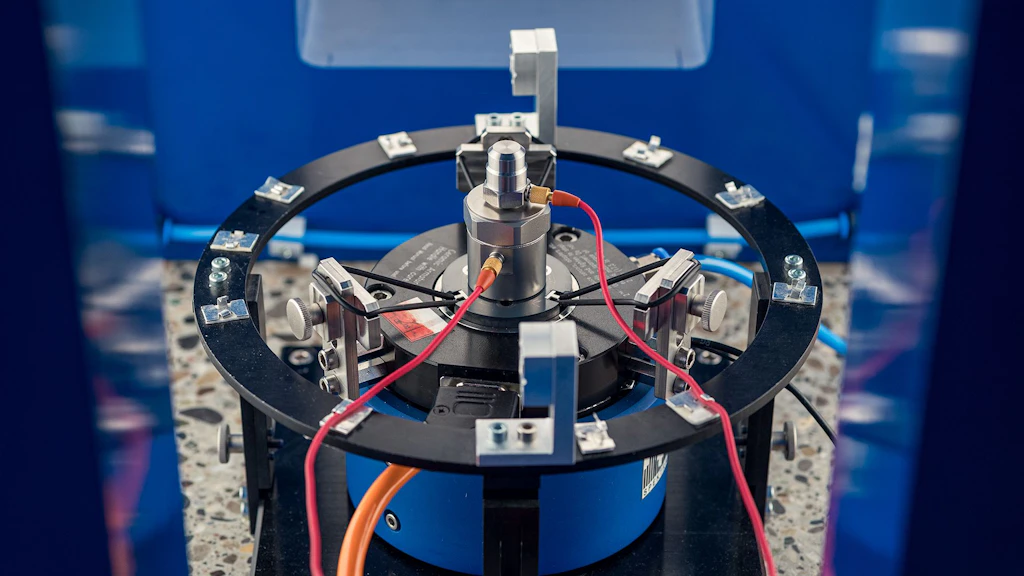
At METAS, we calibrate reference sensors that industrial organisations in turn use to calibrate other sensors and to maintain metrological traceability. Sensors calibrated by METAS can also be used directly for vibration monitoring.
Typical use cases for vibration measurement
Acceleration and vibration sensors are used where movements, vibrations or impacts have to be recorded reliably. Traceable calibration ensures that the readings are comparable and trustworthy. Typical use cases include:
- Vehicle and traffic technology: Transducers for airbag, ESP and chassis systems, and crash and endurance testing
- Mechanical and plant engineering: Condition monitoring and predictive maintenance of rotating machines
- Construction and seismic technology: Monitoring of structures and bridges, and earthquake measurements (seismometers, structural health monitoring)
- Aerospace: Vibration and environmental testing of components and structures
- Testing and calibration laboratories: Calibration of shakers and reference transducers
- Electronics and medical technology: Characterization of MEMS accelerometers
Our services in the field of vibration
Calibrations
Our range of services in the field of vibration mainly involve the calibration of the following measuring instruments and components:
- Calibration of accelerometers
- Calibration of vibration measurement chains
- Calibration of vibration generators
- Calibration of charge amplifiers
- Calibration of artificial mastoids
Is the service you are looking for not listed on the website? Please do not hesitate to contact us so that we can work together to find a customised solution to your problem.
Measuring methods and technologies
Our calibrations in the field of vibration are carried out in line with the ISO 16063-21 standard. The sensor being calibrated is compared with a reference sensor. We cover a frequency range from 0.1 Hz to 20 kHz.
In addition, internal calibrations are carried out in the laboratory in line with the ISO 16063-11 standard. In this process, a sensor is primarily calibrated using a laser and an interferometer to determine acceleration based on a primary measurement. The primary ISO 16063-11 calibration forms the basis for the traceability of our reference sensors and so, in turn, for comparison calibrations under ISO 16063-21.
Quality and expertise
You can find information on the quality of our services on the “Integrated Management System” page.
Enquiry and contact
Laboratory Mass, Force, Pressure and Vibration
Federal Institute of Metrology METAS
Lindenweg 50
3003 Bern-Wabern
Index
More information
Calibration
Our calibrations are based on nationally and internationally traceable references and guarantee the highest measurement accuracy and traceability to the International System of Units (SI) for measuring instruments from industry, research and administration.
Force and weighing instruments: Force measurement
Accurate measurement of forces is an important prerequisite for safe and reliable products. METAS uses newtons as its unit of measurement and ensures comparable measurement results.

Acoustics
In the field of acoustics, METAS deals with the physical measurement of the audible range of sound. In the field of noise and environmental protection, sound level measurements provide reliable measured values with regard to compliance with legal limits for noise emissions and immissions.